— Guides
Glow vs Klow: What the Fourth Peptide Changes
October 4, 2026
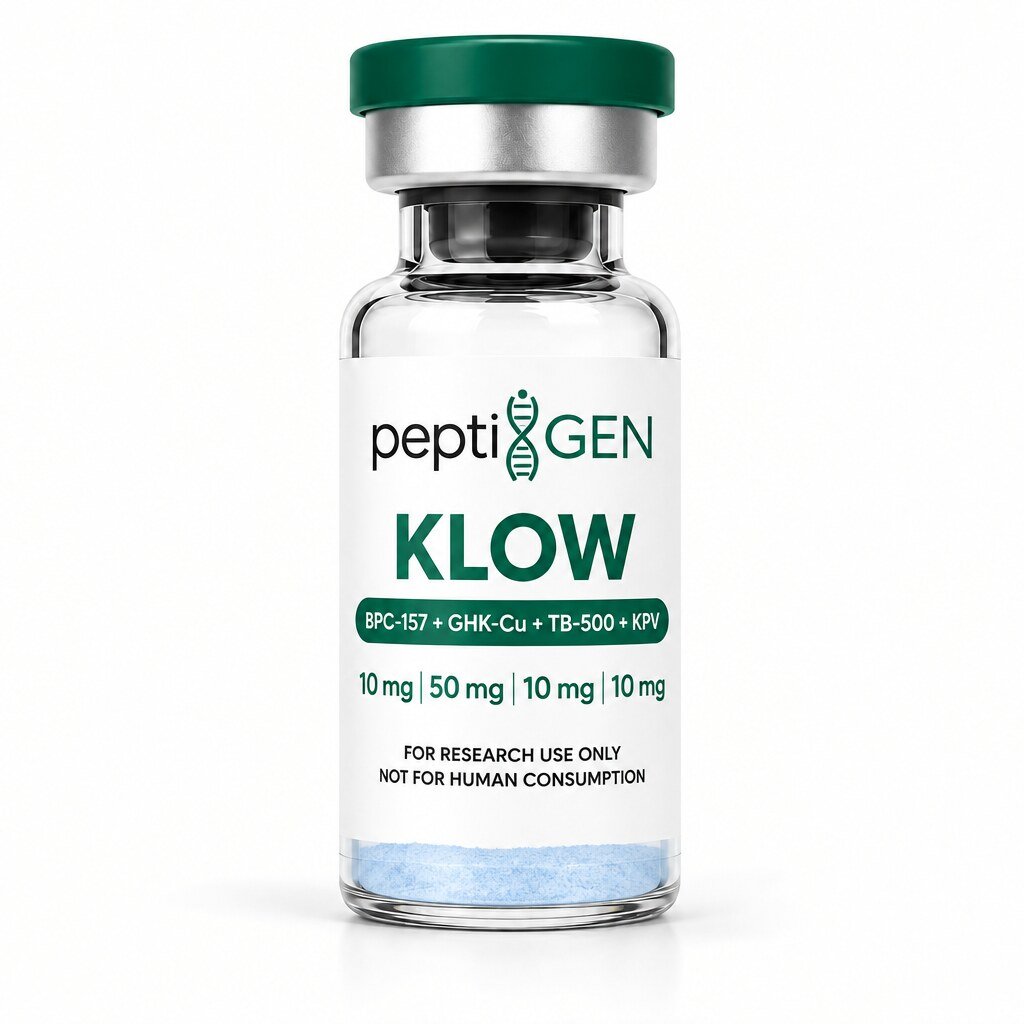
The difference between the two formulations comes down to one component, but that component brings a pathway the other three do not cover. It is worth understanding what each piece does before choosing.
What each one contains
| Component | Glow | Klow |
|---|---|---|
| GHK-Cu | Yes | Yes |
| BPC-157 | Yes | Yes |
| TB-500 | Yes | Yes |
| KPV | No | Yes |
| Total | 3 peptides | 4 peptides |
The three pathways they share
GHK-Cu is a copper tripeptide naturally present in human plasma, whose concentration declines with age. It carries copper into cells, and copper is a cofactor for the enzymes that synthesise and assemble the extracellular matrix. It is the component linked to collagen and elastin.
BPC-157 brings the angiogenesis pathway, mediated by vascular endothelial growth factor: the formation of new vessels that supply a tissue.
TB-500 brings actin dynamics, on which the ability of cells to move toward a remodelling zone depends.
Matrix, blood supply and movement: three axes that do not overlap. That is the logic of Glow.
What KPV adds
KPV is a tripeptide of lysine, proline and valine, corresponding to the C-terminal fragment of alpha-melanocyte-stimulating hormone. Its research interest lies in modulation of the inflammatory response, with particular attention to the NF-κB pathway, one of the central transcription factors of that process.
What matters is that it keeps that activity without carrying the full hormone’s effect on pigmentation. And that it is a different axis from the other three: none of Glow’s components addresses inflammatory signalling.
Which one fits each protocol
If the study centres on extracellular matrix, vascular supply and cell migration, Glow covers those three axes without adding variables.
If the inflammatory component also matters — or you want to observe how that pathway interacts with the other three — Klow is the formulation that incorporates it. In experimental design, every added component is also one more variable, so the choice is not simply “more is better”.
Storage: mind the copper
Both formulations contain GHK-Cu, and the copper complex is sensitive to prolonged light exposure. Once reconstituted, take extra care to protect them from light, as well as keeping them refrigerated between 2 and 8 °C. The solution shows a characteristic bluish tint: it is the expected appearance of the copper complex, not a sign of alteration.
Where to get them
Both are available in our catalogue, with purity analysis per batch:
Orders are confirmed over WhatsApp, where we answer questions about sizes and shipping before closing. The Klow guide goes into each component in more depth.
Frequently asked questions
Is KPV the only difference?
Yes. Glow brings together GHK-Cu, BPC-157 and TB-500; Klow adds KPV as a fourth component. What matters is that KPV brings the inflammatory-modulation pathway, which none of the other three covers.
Is Klow better for having more peptides?
Not necessarily. In experimental design every added component is also one more variable. If the protocol is not interested in the inflammatory axis, the fourth component adds complexity without contributing to the study question.
Why is the solution bluish?
Because of the GHK-Cu: the copper(II) complex has that characteristic tint. It is the expected appearance of both formulations and does not indicate that the material is altered.
Are they reconstituted like a single peptide?
Yes. Bacteriostatic water is added slowly down the wall of the vial and it is rolled gently until dissolved, without shaking. The components come already combined in a single preparation.
Content intended for scientific research and laboratory development. The compounds mentioned are not medicines, have no INVIMA health registration and are not fit for human or animal consumption. This information describes published research lines and is not medical advice.