— Guides
Tirzepatide vs Retatrutide: The Complete Comparison
August 20, 2026
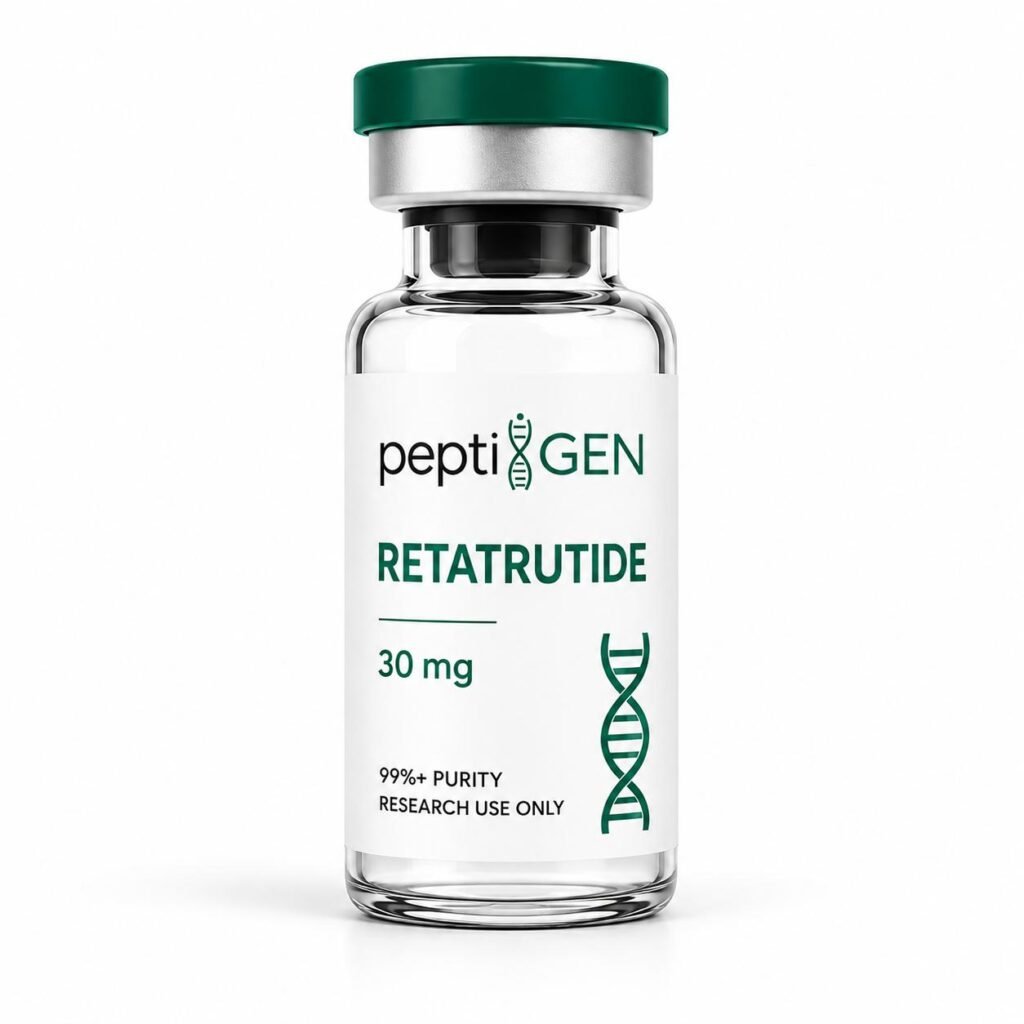
It is the question we get asked most. The two compounds belong to the same family of metabolic research, but they differ in mechanism, in the maturity of their evidence and in regulatory status. Here is the complete comparison, without marketing exaggeration.
The essential difference: two receptors versus three
Both are synthetic peptides developed by Eli Lilly and both act on incretin receptors. The difference is how many:
| Criterion | Tirzepatide | Retatrutide |
|---|---|---|
| Code | LY3298176 | LY3437943 |
| Receptors | GIP + GLP-1 | GIP + GLP-1 + glucagon |
| Classification | Dual agonist | Triple agonist |
| Development phase | Complete; approved in several countries | Phase 3, not approved |
| INVIMA registration | As a medicine, yes; the research material, no | No |
| Volume of evidence | Extensive and mature | Still being built |
What the third receptor adds
Retatrutide’s distinguishing element is activation of the glucagon receptor. It is worth understanding why that drew so much attention.
GLP-1 and GIP are mainly associated with satiety signalling and glucose handling: put simply, they act on the intake side. The glucagon receptor is linked in research to energy expenditure — the other side of the equation.
That is the hypothesis the phase 3 trials are testing. The phase 2 results, published in The New England Journal of Medicine in 2023, showed weight reductions greater than those observed with dual agonists in comparable studies — but comparing across different trials has methodological limits and is not the same as a head-to-head comparison.
Maturity of the evidence: tirzepatide’s advantage
Here the balance tips clearly toward the older compound. Tirzepatide completed its clinical programme, obtained regulatory approval in several countries and accumulates follow-up data in large populations.
Retatrutide, by contrast, is still generating that data. A compound in phase 3 is a compound whose full profile is not yet entirely known. In research that is not a flaw — it is simply the point in the process where it stands.
Which one for a research protocol
There is no universal winner: it depends on the question the study wants to answer.
- If the object of study is the dual GIP/GLP-1 pathway within an established frame of reference, tirzepatide offers the most solid bibliographic backing.
- If the interest lies in the energy-expenditure axis and the triple-agonism mechanism, retatrutide is the relevant compound.
A practical point: retatrutide is available in a wide range of strengths (10, 15, 20, 30, 40 and 50 mg), which gives more room to match yield per vial to the length of the protocol. Tirzepatide we stock in 15, 30, 40 and 60 mg.
Handling and storage: identical
Here there is no difference. Both are distributed lyophilised and share the same requirements:
- Refrigeration at 2–8 °C protected from light; freezing for long-term storage.
- Reduced stability once reconstituted.
- Degradation from repeated freeze–thaw cycles.
- Purity verified by HPLC and mass spectrometry, with a traceable batch.
Where to buy them in Colombia
At Peptigene we stock both compounds in high-purity lyophilised form, dispatched from Medellín to all of Colombia and shipped to the United States and Spain:
- Tirzepatide 30 mg · 15 mg · 40 mg · 60 mg
- Retatrutide 10 mg · 15 mg · 20 mg · 30 mg
For the detail on each, see the retatrutide guide or the tirzepatide guide.
Frequently asked questions
Is retatrutide “more potent” than tirzepatide?
Retatrutide’s phase 2 data showed greater weight reductions than those reported for dual agonists in separate trials. But comparing results across studies with different designs, populations and durations has clear methodological limits. Until head-to-head comparisons exist, the claim is not established.
Can they be combined?
We do not supply protocols or guidance on combinations. Both are research materials and their use belongs exclusively to the researcher’s experimental design.
Why does retatrutide usually cost more?
The synthesis complexity of the triple agonist and its lower production volume compared with an established compound both play a part. Vial strength matters too: comparing prices without looking at the milligrams leads to wrong conclusions.
Notice. This article is for information only and concerns compounds intended for scientific research and laboratory development. It is not medical advice and not a recommendation for use in humans. None of the materials we sell holds an INVIMA health registration for human consumption. Always consult a qualified healthcare professional before making any decision about your health.