Description
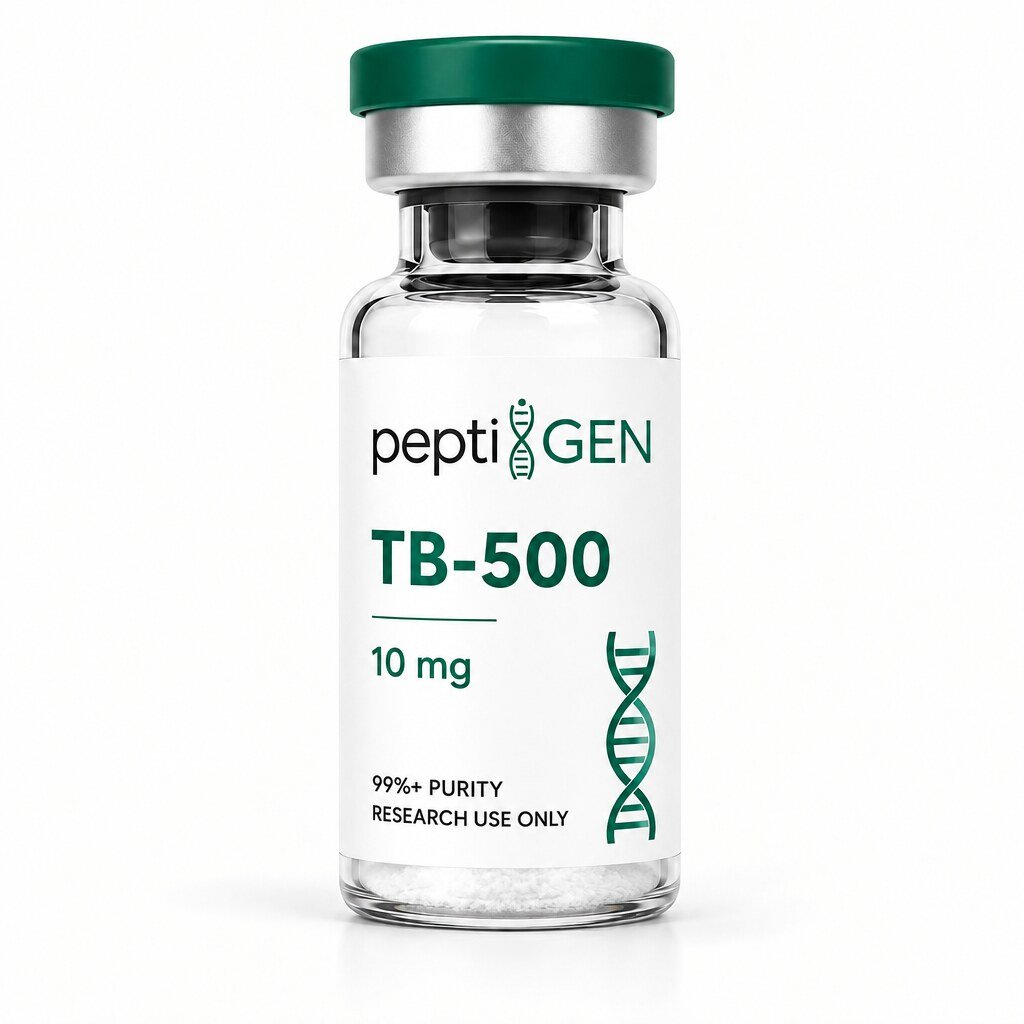
TB-500 10mg is a high-purity lyophilized research compound supplied for scientific research and laboratory development only. This presentation contains 10 mg per vial. Every batch is analyzed by HPLC for purity and by mass spectrometry for identity; the certificate of analysis is available on request.
Mechanism of action
TB-500 is a synthetic 7-amino-acid fragment (Ac-LKKTETQ) corresponding to residues 17-23 of thymosin beta-4, its actin-binding domain. It is not the full 43-amino-acid protein, and the clinical trials that exist were run with the full protein, not with this fragment.
What TB-500 actually is
There is a widespread confusion here that needs clearing up, because it affects how the literature is read.
TB-500 and thymosin beta-4 are not the same thing.
- Thymosin beta-4 (Tβ4) is an endogenous peptide of 43 amino acids, naturally present in practically every tissue and especially abundant in platelets.
- TB-500 is a synthetic acetylated 7-amino-acid fragment, sequence Ac-LKKTETQ, corresponding to residues 17 to 23 of that protein: the actin-binding domain.
In other words, TB-500 reproduces the functional region responsible for the interaction with actin, not the complete protein.
Mechanism in detail
The mechanism revolves around actin, one of the most abundant proteins of the cytoskeleton.
Thymosin beta-4 is the body’s main monomeric-actin (G-actin) sequestering protein. By binding those monomers it regulates how many remain available to polymerize into filaments (F-actin), and a cell’s ability to change shape and move depends directly on that polymerization.
The actin-binding domain, precisely what TB-500 reproduces, is the region that mediates that interaction. That is why the molecule is investigated in cell migration and tissue-remodeling contexts rather than in classic receptor-signaling pathways.
The actual state of the evidence
This distinction is the most important one on this page, and almost no supplier makes it.
The clinical trials that exist are of full-length thymosin beta-4, not of the TB-500 fragment. The 43-amino-acid protein has been investigated in humans under its own pharmaceutical designations:
- A 0.1 % ophthalmic formulation completed phase II and phase III trials in dry eye and neurotrophic keratopathy, with orphan-drug designation.
- Another formulation was investigated for cardiac repair after myocardial infarction.
- Phase I safety studies in healthy volunteers also exist.
TB-500, as a synthetic fragment, rests mainly on preclinical evidence. Attributing the clinical results of the full protein to it would be a methodological error.
Regulatory and anti-doping status
Thymosin beta-4 appears on the World Anti-Doping Agency Prohibited List, in category S2.2 — peptide hormones, growth factors, related substances and mimetics, prohibited in and out of competition.
| Nature of TB-500 | Synthetic 7-amino-acid fragment (Ac-LKKTETQ) |
|---|---|
| Corresponds to | Residues 17-23 of thymosin beta-4 |
| Clinical evidence | Of the full protein, not the fragment |
| INVIMA registration | None |
| WADA list | S2.2, in and out of competition |
Safety: what is known and what is not
This should be answered clearly, because a lot of confusing information circulates.
There is no established human safety profile for this compound. It is not that studies found problems: it is that the studies that would establish such a profile have not been done. Those are two very different situations and they should not be confused.
What does exist:
- Preclinical literature, in cell and animal models, describing mechanisms of action.
- Analytical characterization of the material: purity by HPLC and identity by mass spectrometry.
What does not exist:
- Advanced-phase clinical trials establishing safety and efficacy in humans.
- Regulatory-agency approval for therapeutic use.
- INVIMA sanitary registration.
That is why the material is classified as a research reagent and not as a medicine. A supplier claiming otherwise is selling something it cannot support.
Specifications
| Compound | TB-500 |
|---|---|
| Vial content | 10 mg |
| Form | Lyophilized powder in a sealed vial |
| Purity | Verified by HPLC, ≥ 99 % |
| Identity | Confirmed by mass spectrometry |
| Storage | Unreconstituted: controlled room temperature, away from light. Reconstituted: 2–8 °C. |
| Documentation | Certificate of analysis per batch, on request |
| Intended use | Scientific research and laboratory development |
Quality control and certificate of analysis
Every lot is analyzed before it is offered. Two independent tests are involved, and they answer different questions:
- HPLC (high-performance liquid chromatography) measures purity: what proportion of the sample is a single compound. The specification for this material is ≥ 99 %.
- Mass spectrometry confirms identity: that the compound’s measured mass matches the theoretical mass of the expected sequence.
Purity and identity are not the same thing: a sample can be 99 % pure of something that is not what was ordered. That is why both are reported. The certificate of analysis (CoA) of the lot, with its lot number, chromatogram and purity figure, is sent on request through WhatsApp before or after the order. If you are comparing suppliers, our guide on how to verify a peptide supplier explains how to read a CoA and which questions to ask.
Reconstitution and handling
The material ships lyophilized, its most stable form for transport and storage. For use in a protocol it is reconstituted with bacteriostatic water, which contains benzyl alcohol as a preservative and allows several draws from the same vial.
- Let the vial reach room temperature before opening, to avoid condensation.
- Disinfect both stoppers with isopropyl alcohol.
- Add the water slowly down the inner wall of the vial, never directly onto the powder.
- Swirl gently until fully dissolved. Do not shake: agitation can denature the peptide.
- Label with date and concentration, and refrigerate at 2–8 °C protected from light.
Bacteriostatic water available: Bacteriostatic Water 10 ml · Bacteriostatic Water 3 ml · Bacteriostatic Water 30 ml.
Storage and stability
Lyophilized peptides are stable compounds when kept dry, cold and in the dark. In practice:
- Unopened, lyophilized: controlled room temperature is acceptable for transport and short periods; for storage beyond a few weeks, keep refrigerated (2–8 °C) or frozen (−20 °C), always protected from light. Let the vial reach room temperature before opening so that no condensation forms on the powder.
- Reconstituted: refrigerate at 2–8 °C, protected from light, and use within the time frame of the protocol. Do not freeze the reconstituted solution repeatedly: freeze–thaw cycles degrade peptides.
- Multi-draw vials: when reconstituted with bacteriostatic water, the benzyl alcohol inhibits bacterial growth after the stopper is pierced, which is what allows several draws; the usual laboratory convention is to discard a multi-dose vial 28 days after the first puncture.
Research lines
- Actin dynamics and cell migration
- Tissue remodeling
- Comparison with full-length thymosin beta-4
Related guides
Technical articles from our research-guides section that expand on this compound and on how to evaluate a supplier:
Frequently asked questions
Is TB-500 the same as thymosin beta-4?
No. Thymosin beta-4 is a 43-amino-acid protein; TB-500 is a 7-amino-acid fragment reproducing its actin-binding domain.
Is it prohibited in sport?
Thymosin beta-4 is listed by WADA under S2.2, prohibited in and out of competition.
Is TB-500 the same as thymosin beta-4?
No. Thymosin beta-4 is an endogenous peptide of 43 amino acids. TB-500 is a synthetic acetylated fragment of only 7 amino acids, Ac-LKKTETQ, corresponding to residues 17 to 23 of that protein: the actin-binding domain. It reproduces the functional region, not the whole molecule.
Are the clinical trials about TB-500?
No, and the distinction should not be overlooked. The human trials, ophthalmic phase II and III, cardiac, and phase I safety, were run with full-length thymosin beta-4. TB-500, as a fragment, rests mainly on preclinical evidence.
Is it banned in sport?
Yes. Thymosin beta-4 is on the World Anti-Doping Agency Prohibited List, category S2.2, prohibited both in and out of competition.
Is it safe?
There is no established human safety profile. The distinction matters: it is not that studies found problems, but that the studies that would establish such a profile have not been carried out. What does exist is preclinical literature on mechanisms and analytical characterization of the material.
Does it have documented side effects?
Not in an established way in humans, because there are no advanced-phase clinical trials that characterized them. The available literature is preclinical, in cell and animal models, and describes mechanisms of action, not human safety profiles.
What does the certificate of analysis include?
The lot number, the HPLC chromatogram with the purity figure (specification ≥ 99 %) and the mass-spectrometry identity confirmation. It is sent on request through WhatsApp, before or after the order.
How should it be stored?
Lyophilized: cold, dry and in the dark; refrigerated or frozen for long storage, with the vial brought to room temperature before opening. Reconstituted: 2–8 °C, protected from light, without repeated freezing.
How do I place an order?
Through WhatsApp, in English or Spanish. We confirm availability, shipping cost to your city or country and the payment method before closing the order. There is no online checkout and we do not store card data.
How is it shipped?
Lyophilized, in discreet packaging with a tracking number, across Colombia and to the United States and Spain. Orders are confirmed on WhatsApp in English or Spanish.
References
- Literature on thymosin beta-4 as a 43-amino-acid endogenous actin-sequestering peptide and its actin-binding domain.
- Clinical-trial programs with full-length thymosin beta-4: 0.1 % ophthalmic formulation (phases II and III in dry eye and neurotrophic keratopathy) and the cardiac-repair formulation.
- World Anti-Doping Agency — Prohibited List, category S2.2.
Product intended exclusively for scientific research and laboratory development. Not for human or animal consumption. It is not a medicine and holds no INVIMA sanitary registration. The information on this page describes published research lines and does not constitute medical advice.
Reviews
There are no reviews yet.