— Guides
Klow: Guide to the BPC-157, TB-500, GHK-Cu and KPV Blend
August 20, 2026
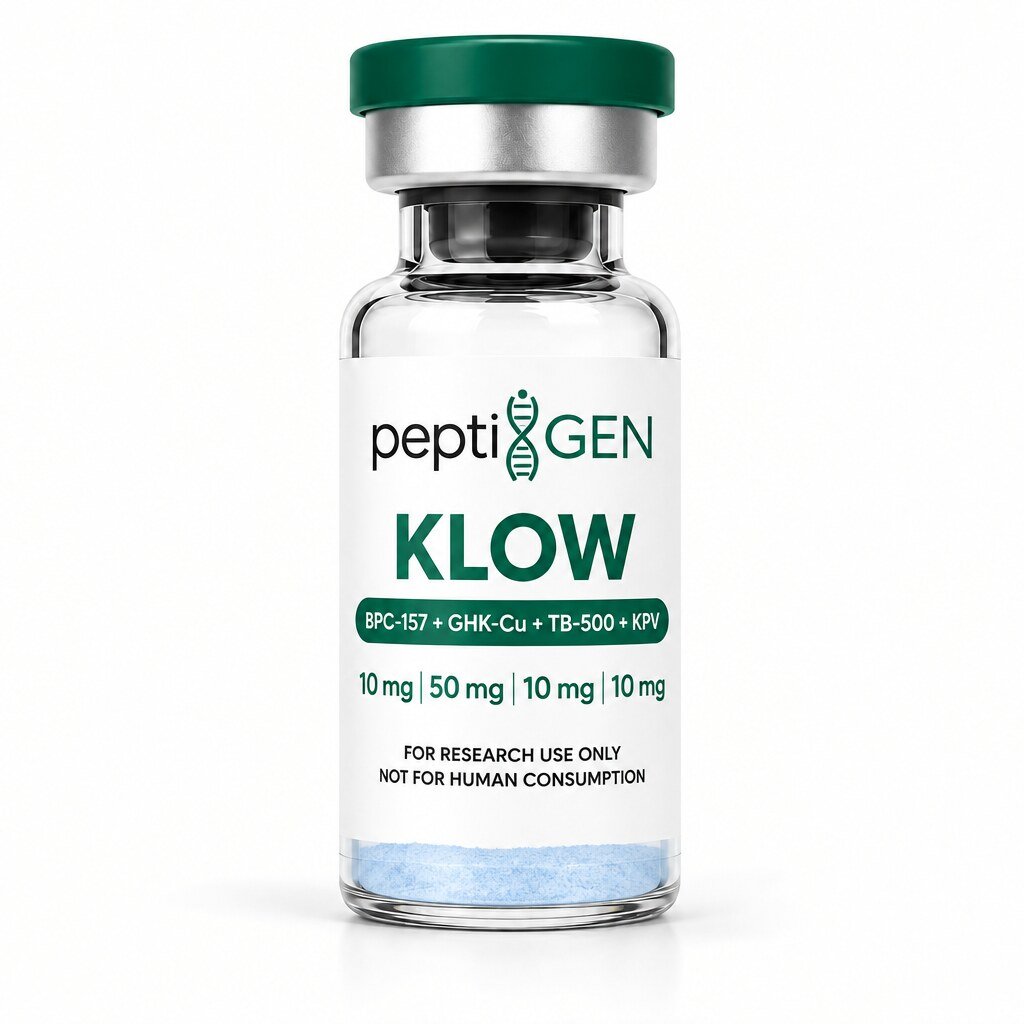
Klow is not one peptide: it is four in the same vial. This guide explains what each component of the blend contributes, why they are combined and what it means to work with a multi-compound formulation instead of isolated compounds.
What Klow is
Klow is a combined formulation that brings together four research peptides in a single lyophilised vial. Its name comes from the initials of its components. The combination is aimed at tissue-repair studies, approaching the process through several signalling pathways at once rather than a single one.
The four components
BPC-157
A pentadecapeptide derived from a sequence identified in human gastric juice. It is probably the most studied peptide of the group in repair models: the literature documents research on connective tissue, the gastrointestinal tract and angiogenesis. Almost all of that evidence comes from animal models.
TB-500
A synthetic fragment related to thymosin beta-4, a protein naturally present in the body. It is studied for its role in cell migration and actin regulation, processes central to tissue repair.
GHK-Cu
The copper tripeptide, with five decades of research on extracellular matrix and collagen production. We have a dedicated GHK-Cu guide if you want the detail.
KPV
A tripeptide derived from the end of the hormone alpha-MSH. It is researched mainly for its role in modulating the inflammatory response, a pathway distinct from those of the other three components.
Why combine them
The logic of the blend is that the four compounds act on different pathways of the same process: structural signalling (GHK-Cu), cell migration (TB-500), angiogenesis and connective tissue (BPC-157) and the inflammatory response (KPV).
It is worth saying precisely: that four compounds act on complementary pathways does not demonstrate that their combination produces a synergistic effect. Synergy is a hypothesis that requires trials designed to test it, and the specific research on this particular combination is considerably thinner than what is available for each peptide on its own.
Blend or separate compounds
It is an experimental-design decision with real implications:
| Blend | Separate compounds | |
|---|---|---|
| Handling | One vial | Four vials |
| Cost | Lower than buying all four | Higher |
| Control of ratios | Fixed by the manufacturer | Total |
| Attribution of results | Cannot isolate each one’s effect | Yes |
The blend’s underlying limitation is methodological: if you observe a result, you cannot attribute it to a specific component. For a protocol that seeks to identify which pathway produces which effect, isolated compounds are the right choice.
Available vial size
We stock Klow 80 mg in a high-purity lyophilised vial, with the four peptides in a single presentation.
What to check when buying a blend
Blends demand an extra level of scrutiny compared with a single compound:
- Composition declared per milligram. A serious blend specifies how much each component contributes, not just the total.
- Batch analysis confirming the presence and proportion of the four compounds.
- Bluish tint of the lyophilised powder, contributed by the GHK-Cu. A completely white Klow is grounds for suspicion.
- Intact seal and homogeneous, moisture-free powder.
Storage
Refrigeration at 2–8 °C protected from light, freezing for long periods. Because of the GHK-Cu, protection from light is especially relevant for this blend. Avoid repeated freeze–thaw cycles.
Frequently asked questions
What do the 80 mg mean?
They are the vial’s total content, split among the four peptides according to the formulation. When comparing prices between blends, always look at the composition per component and not just the total.
How does it differ from the “Glow” blend?
Glow-type formulations usually combine three peptides (BPC-157, TB-500 and GHK-Cu). Klow adds KPV, which contributes the inflammatory-modulation pathway. We compare them in detail in Glow vs Klow.
Does it have INVIMA registration?
No. None of the four components holds a health registration for human consumption in Colombia. They are sold exclusively as research material.
Notice. This article is for information only and concerns compounds intended for scientific research and laboratory development. It is not medical advice and not a recommendation for use in humans. Always consult a qualified healthcare professional before making any decision about your health.