— Guides
SLU-PP-332: Guide to the Pan-ERR Agonist
August 20, 2026
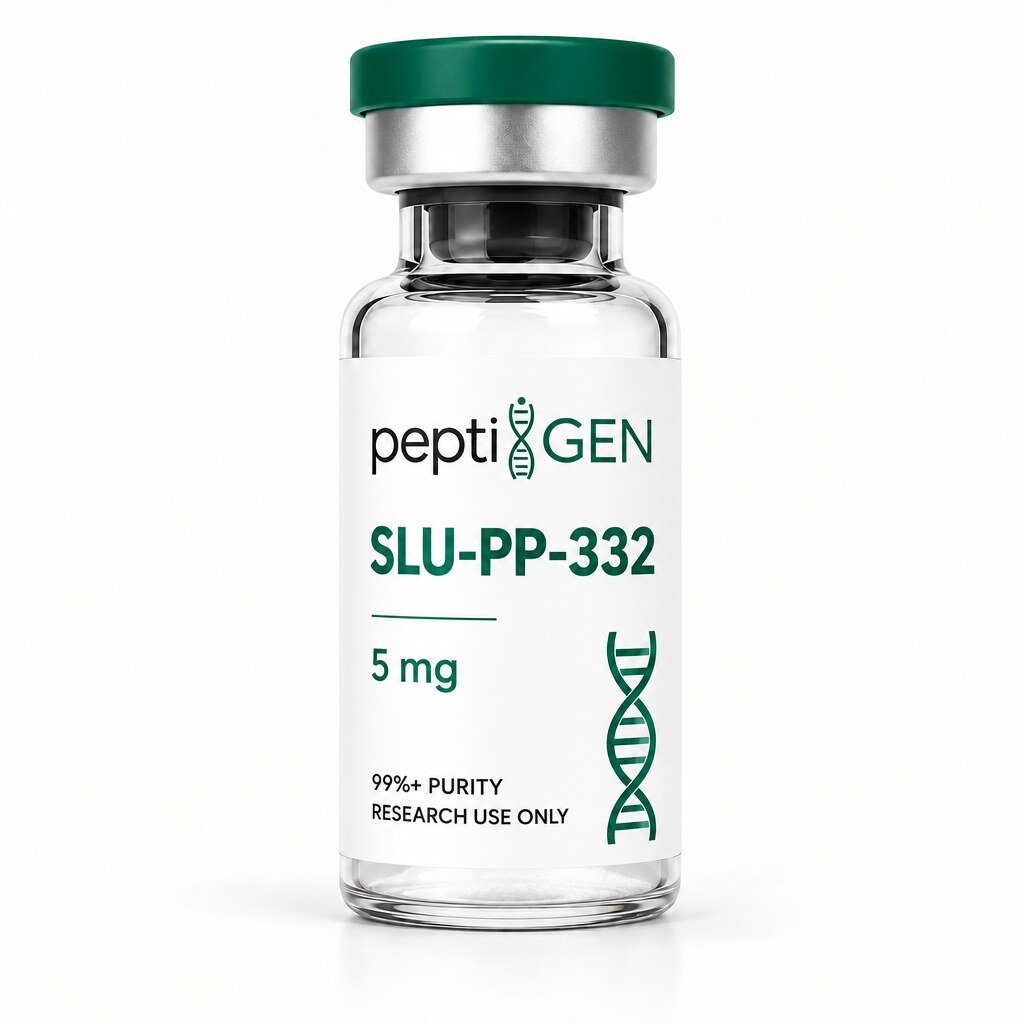
SLU-PP-332 is the newest and least conventional compound in our catalogue: it is not a peptide, and its mechanism has nothing to do with incretins. This guide explains what an ERR agonist is, why it was called “exercise in a pill” and why that label is misleading.
What SLU-PP-332 is
First, because it causes constant confusion: SLU-PP-332 is not a peptide. It is a synthetic small molecule, a low-molecular-weight chemical compound. It is grouped commercially with peptides because it shares the same research distribution channel, but it belongs to another chemical category.
Its name comes from Saint Louis University (SLU), where it was developed. It is described as a pan-ERR agonist: it activates all three estrogen-related receptors — ERRα, ERRβ and ERRγ.
What ERR receptors are
Despite the name, estrogen-related receptors are not estrogen receptors and do not bind that hormone. They are orphan nuclear receptors, named for their structural similarity to estrogen receptors, not for their function.
Research links them to the regulation of mitochondrial energy metabolism: mitochondrial biogenesis, fatty-acid oxidation and the oxidative capacity of skeletal muscle. These are pathways that, under physiological conditions, are activated by endurance exercise.
Why it was called “exercise in a pill”
The label came from media coverage of the preclinical studies published in 2023, which described, in animal models, increases in endurance capacity and changes in fat metabolism without any increase in physical activity.
It is an attractive headline and a poor description. Exercise produces cardiovascular, neuromuscular, skeletal, endocrine and cognitive adaptations that no compound reproduces. What the studies describe is the activation of one of the many pathways that exercise mobilises. Confusing the two is exactly the kind of oversimplification to avoid when evaluating a research compound.
State of the research
This is the most important point of the guide. SLU-PP-332 is at a strictly preclinical stage. Its data come from in vitro studies and animal models, mainly rodents.
Compared with the other compounds in our catalogue, the gap in maturity is enormous:
| Compound | Phase |
|---|---|
| Tirzepatide | Approved in several countries |
| Retatrutide | Phase 3 |
| SLU-PP-332 | Preclinical |
There are no clinical trials in humans. Its safety profile in humans is, simply, unknown. It is a research compound in the most literal sense of the term.
Available vial size
We stock SLU-PP-332 5 mg in a high-purity lyophilised presentation for research on energy metabolism and fat oxidation.
Quality and storage
Being a small molecule rather than a peptide, its identity and purity analysis is done by HPLC together with spectroscopic techniques. It likewise requires a traceable batch with its certificate of analysis: with a compound that has so little literature available, supplier verification matters even more.
Store refrigerated, protected from light and moisture. Freeze for long-term storage.
Frequently asked questions
Is it a SARM?
No. SARMs act on the androgen receptor. SLU-PP-332 acts on ERR receptors, which belong to another family and regulate different metabolic pathways.
How does it compare with retatrutide?
They share a field of study — metabolism — but through completely different pathways: retatrutide acts on incretin receptors and SLU-PP-332 on mitochondrial nuclear receptors. Their development stages are not comparable either. If the contrast between metabolic compounds interests you, see our tirzepatide vs retatrutide comparison.
Does it have INVIMA registration?
No, and it will not have one in the short term: a compound at the preclinical stage is years away from any regulatory application. It is sold exclusively as research material.
Notice. This article is for information only and concerns compounds intended for scientific research and laboratory development. SLU-PP-332 is at the preclinical stage, has not been evaluated in human clinical trials and its safety profile in humans is unknown. This content is not medical advice and not a recommendation for use. Always consult a qualified healthcare professional before making any decision about your health.