— Guides
MOTS-c: Guide to the Mitochondrial Peptide
September 12, 2026
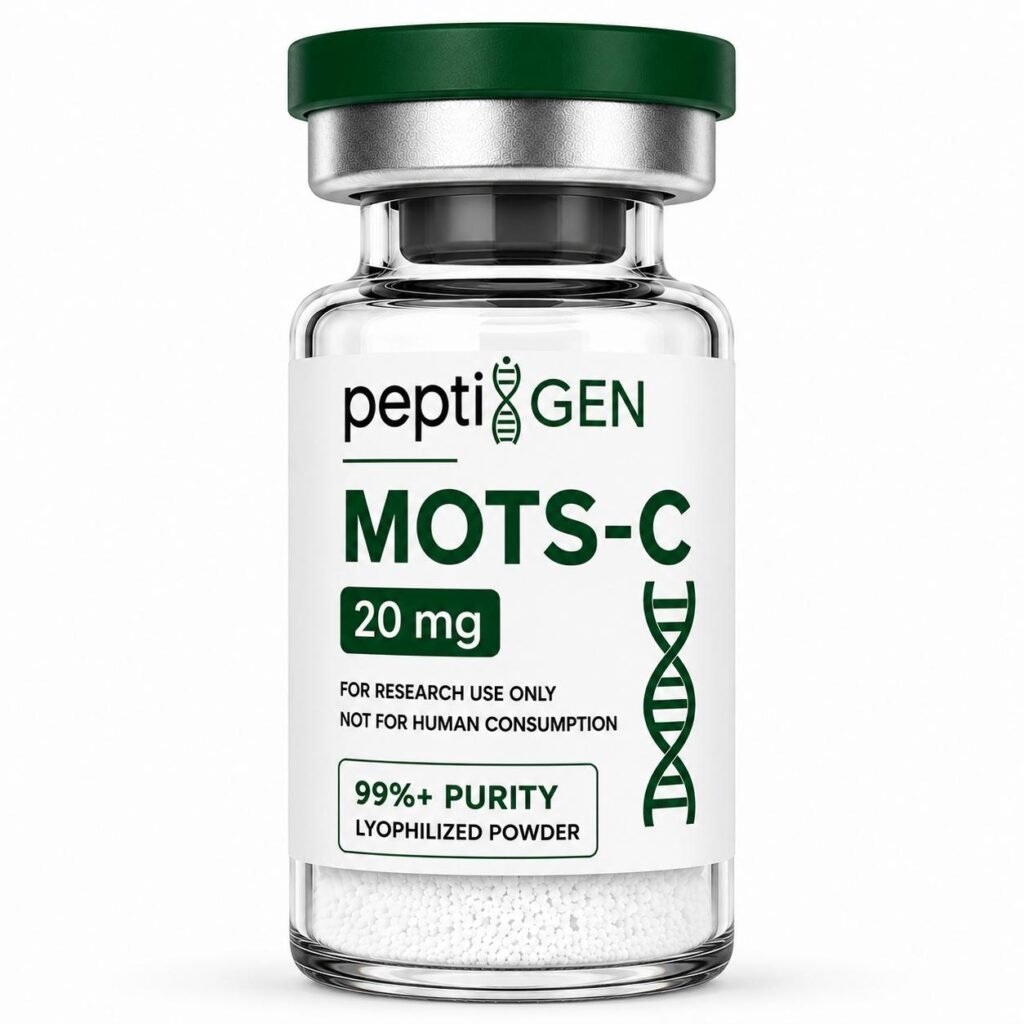
MOTS-c broke an idea that was considered settled: that every protein in the body is encoded in the nucleus. This one is not. It is written in the DNA of the mitochondrion, and that detail is what makes it interesting.
What MOTS-c is
MOTS-c is a 16-amino-acid peptide described in 2015. What is special about it is not the sequence but the origin: it is encoded in mitochondrial DNA, not nuclear DNA.
For decades it was assumed that the mitochondrion made only a handful of proteins for its own respiratory machinery. The discovery of peptides such as MOTS-c and Humanin changed that idea: the mitochondrion also sends signals to the rest of the cell. That family is called mitochondrial-derived peptides.
The AMPK pathway
MOTS-c’s best-documented mechanism runs through AMPK, an enzyme that works as a sensor of the cell’s energy state. When available energy drops, AMPK switches on and tells the cell to change mode: store less, produce more.
It is the same pathway activated by exercise and caloric restriction. That is why the literature describes MOTS-c as a compound studied in the context of metabolic homeostasis, and why it is sometimes labelled an “exercise mimetic” — a simplification best taken with a pinch of salt.
Research lines
- Insulin sensitivity and glucose uptake in skeletal muscle.
- Energy metabolism and substrate utilisation.
- Mitochondria–nucleus communication, a relatively new field.
- Metabolic ageing. Research describes a decline in its circulating levels with age.
As befits a compound described a decade ago, the evidence comes from cell and animal models. There are no large-scale clinical trials in humans.
What sets it apart from metabolic agonists
It is worth placing it next to the compounds in the weight management category, because they get confused:
| Compound | Acts on |
|---|---|
| Retatrutide / Tirzepatide | Incretin receptors (satiety signal) |
| Cagrilintide | Amylin receptor |
| MOTS-c | AMPK pathway, inside the cell |
| SLU-PP-332 | ERR nuclear receptors |
The first ones act on surface receptors and modulate hormonal signals. MOTS-c and SLU-PP-332 operate on internal cell metabolism. They are different research questions, not versions of the same thing.
Available vial sizes
- MOTS-c 10 mg — entry size.
- MOTS-c 20 mg — intermediate.
- MOTS-c 40 mg — the best yield per vial.
All three in high-purity lyophilised vials. The choice depends on the length of the protocol: more strength yields more per milligram, but means keeping the reconstituted vial for longer.
Regulatory status
It is not approved as a medicine in any country and has no INVIMA health registration. It is sold exclusively as research material.
Quality and storage
Purity above 99% by HPLC with mass-spectrometry confirmation, traceable batch, homogeneous lyophilised powder and intact seal. Refrigeration at 2–8 °C protected from light, freezing for long periods, and reduced stability once reconstituted.
Frequently asked questions
Is it the same as Humanin?
No, although they belong to the same family. Both are encoded in mitochondrial DNA, but Humanin — the first to be described — is researched mainly in cytoprotection and the cellular stress response, whereas MOTS-c is studied in energy metabolism.
Does it replace exercise?
No. The “exercise mimetic” label comes from the fact that it activates one of the pathways exercise also activates. Exercise produces cardiovascular, neuromuscular, skeletal and cognitive adaptations that no molecule reproduces.
Which size is right?
The 10 mg for short or exploratory protocols; the 40 mg when the study runs longer and the yield per milligram pays off. The 20 mg is the midpoint.
Notice. This article is for information only and concerns compounds intended for scientific research and laboratory development. It is not medical advice and not a recommendation for use in humans. MOTS-c has no INVIMA health registration. Always consult a qualified healthcare professional before making any decision about your health.