Description
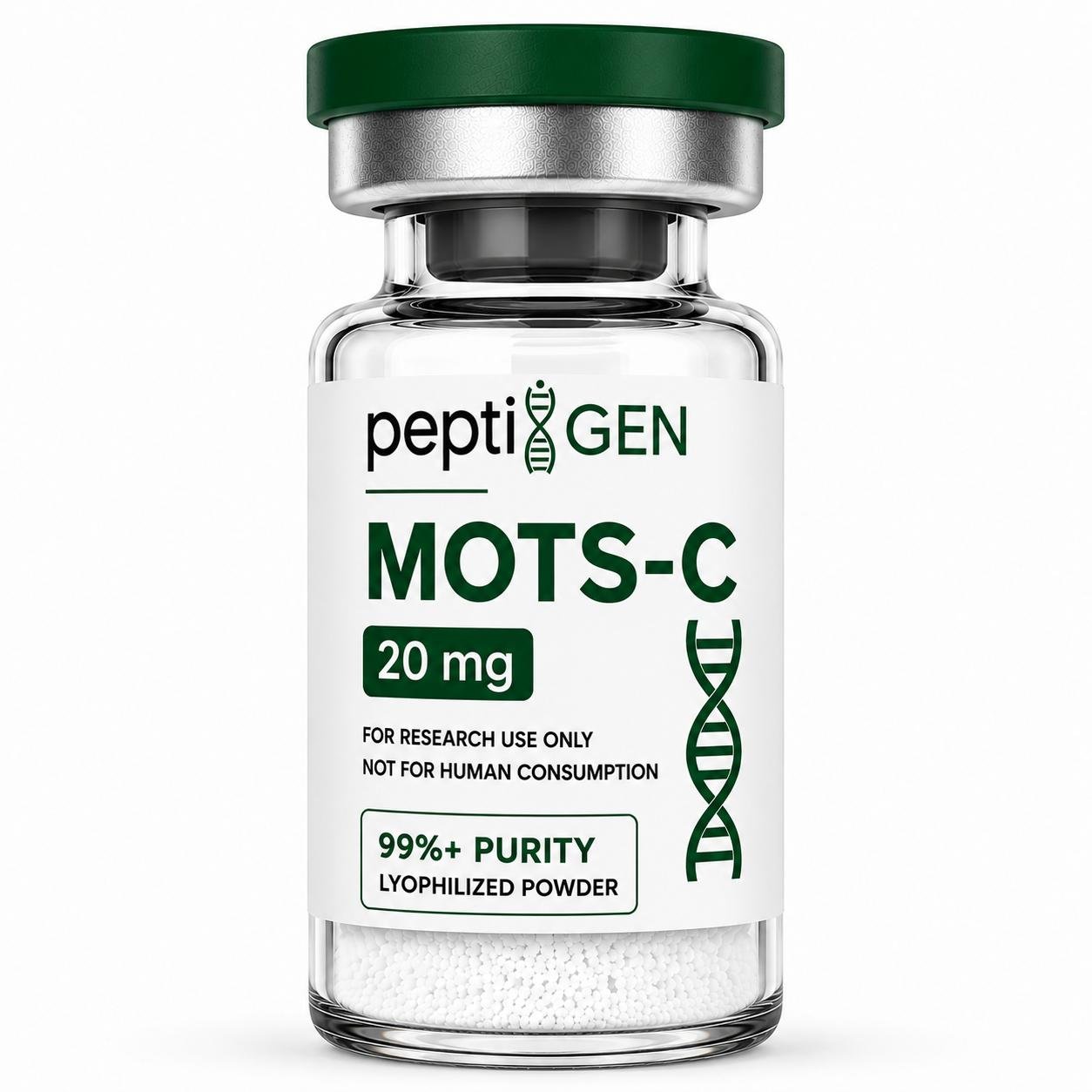
MOTS-c 20mg is a high-purity lyophilized research compound supplied for scientific research and laboratory development only. This presentation contains 20 mg per vial. Every batch is analyzed by HPLC for purity and by mass spectrometry for identity; the certificate of analysis is available on request.
Mechanism of action
MOTS-c is a 16-amino-acid peptide encoded by the mitochondrial 12S rRNA gene, not the nuclear genome. It activates AMPK, the cell’s central energy sensor, and takes part in mitochondrial biogenesis and retrograde mitochondria-to-nucleus signaling.
A peptide written in the mitochondrial genome
MOTS-c is a 16-amino-acid peptide with an unusual feature: it is not encoded by the nuclear genome but by the 12S ribosomal RNA gene of mitochondrial DNA.
That places it in a relatively recently discovered category, mitochondrial-derived peptides, which opened its own line of metabolic research. Under resting conditions it is located inside the mitochondrion.
Mechanism: the cell’s energy sensor
Its documented pathway is activation of AMPK, AMP-activated protein kinase, regarded as the cell’s central energy sensor: it detects when available energy is scarce and readjusts metabolism accordingly.
Through that pathway, MOTS-c also takes part in mitochondrial biogenesis and in the regulation of nuclear genes. That last point is the most interesting: a mitochondria-encoded peptide that ends up influencing nuclear expression. The literature calls that mitochondria-to-nucleus communication retrograde signaling, and it is the central object of its study.
| Length | 16 amino acids |
|---|---|
| Encoded by | Mitochondrial 12S rRNA gene |
| Main pathway | AMPK activation |
| Associated lines | Mitochondrial biogenesis · nuclear gene regulation |
Specifications
| Compound | MOTS-c |
|---|---|
| Vial content | 20 mg |
| Form | Lyophilized powder in a sealed vial |
| Purity | Verified by HPLC, ≥ 99 % |
| Identity | Confirmed by mass spectrometry |
| Storage | Unreconstituted: controlled room temperature, away from light. Reconstituted: 2–8 °C. |
| Documentation | Certificate of analysis per batch, on request |
| Intended use | Scientific research and laboratory development |
Quality control and certificate of analysis
Every lot is analyzed before it is offered. Two independent tests are involved, and they answer different questions:
- HPLC (high-performance liquid chromatography) measures purity: what proportion of the sample is a single compound. The specification for this material is ≥ 99 %.
- Mass spectrometry confirms identity: that the compound’s measured mass matches the theoretical mass of the expected sequence.
Purity and identity are not the same thing: a sample can be 99 % pure of something that is not what was ordered. That is why both are reported. The certificate of analysis (CoA) of the lot, with its lot number, chromatogram and purity figure, is sent on request through WhatsApp before or after the order. If you are comparing suppliers, our guide on how to verify a peptide supplier explains how to read a CoA and which questions to ask.
Reconstitution and handling
The material ships lyophilized, its most stable form for transport and storage. For use in a protocol it is reconstituted with bacteriostatic water, which contains benzyl alcohol as a preservative and allows several draws from the same vial.
- Let the vial reach room temperature before opening, to avoid condensation.
- Disinfect both stoppers with isopropyl alcohol.
- Add the water slowly down the inner wall of the vial, never directly onto the powder.
- Swirl gently until fully dissolved. Do not shake: agitation can denature the peptide.
- Label with date and concentration, and refrigerate at 2–8 °C protected from light.
Bacteriostatic water available: Bacteriostatic Water 10 ml · Bacteriostatic Water 3 ml · Bacteriostatic Water 30 ml.
Storage and stability
Lyophilized peptides are stable compounds when kept dry, cold and in the dark. In practice:
- Unopened, lyophilized: controlled room temperature is acceptable for transport and short periods; for storage beyond a few weeks, keep refrigerated (2–8 °C) or frozen (−20 °C), always protected from light. Let the vial reach room temperature before opening so that no condensation forms on the powder.
- Reconstituted: refrigerate at 2–8 °C, protected from light, and use within the time frame of the protocol. Do not freeze the reconstituted solution repeatedly: freeze–thaw cycles degrade peptides.
- Multi-draw vials: when reconstituted with bacteriostatic water, the benzyl alcohol inhibits bacterial growth after the stopper is pierced, which is what allows several draws; the usual laboratory convention is to discard a multi-dose vial 28 days after the first puncture.
Research lines
- AMPK activation
- Mitochondrial biogenesis
- Retrograde signaling
Other presentations of MOTS-c
Related guides
Technical articles from our research-guides section that expand on this compound and on how to evaluate a supplier:
Frequently asked questions
What does mitochondrial encoding mean?
That its genetic information sits in mitochondrial DNA rather than the nucleus, a recently described class of peptides.
What is AMPK?
The central cellular energy sensor, which detects low energy availability and adjusts metabolism.
What does it mean that it is encoded by the mitochondrion?
That its genetic information is not in the cell nucleus like almost every protein's, but in the 12S ribosomal RNA gene of mitochondrial DNA. It is a recently discovered category of peptides that opened its own line of research.
What is retrograde signaling?
Communication going from the mitochondrion to the nucleus, the opposite of the usual direction. MOTS-c is one of the studied examples: a mitochondria-encoded peptide that ends up influencing the expression of nuclear genes.
What does the certificate of analysis include?
The lot number, the HPLC chromatogram with the purity figure (specification ≥ 99 %) and the mass-spectrometry identity confirmation. It is sent on request through WhatsApp, before or after the order.
How should it be stored?
Lyophilized: cold, dry and in the dark; refrigerated or frozen for long storage, with the vial brought to room temperature before opening. Reconstituted: 2–8 °C, protected from light, without repeated freezing.
How do I place an order?
Through WhatsApp, in English or Spanish. We confirm availability, shipping cost to your city or country and the payment method before closing the order. There is no online checkout and we do not store card data.
How is it shipped?
Lyophilized, in discreet packaging with a tracking number, across Colombia and to the United States and Spain. Orders are confirmed on WhatsApp in English or Spanish.
References
- Reviews on MOTS-c as a mitochondrial-derived peptide and its therapeutic potential (literature indexed in PubMed Central).
- Literature on the AMPK pathway as a cellular energy sensor and on mitochondria-nucleus retrograde signaling.
Product intended exclusively for scientific research and laboratory development. Not for human or animal consumption. It is not a medicine and holds no INVIMA sanitary registration. The information on this page describes published research lines and does not constitute medical advice.
Reviews
There are no reviews yet.