Description
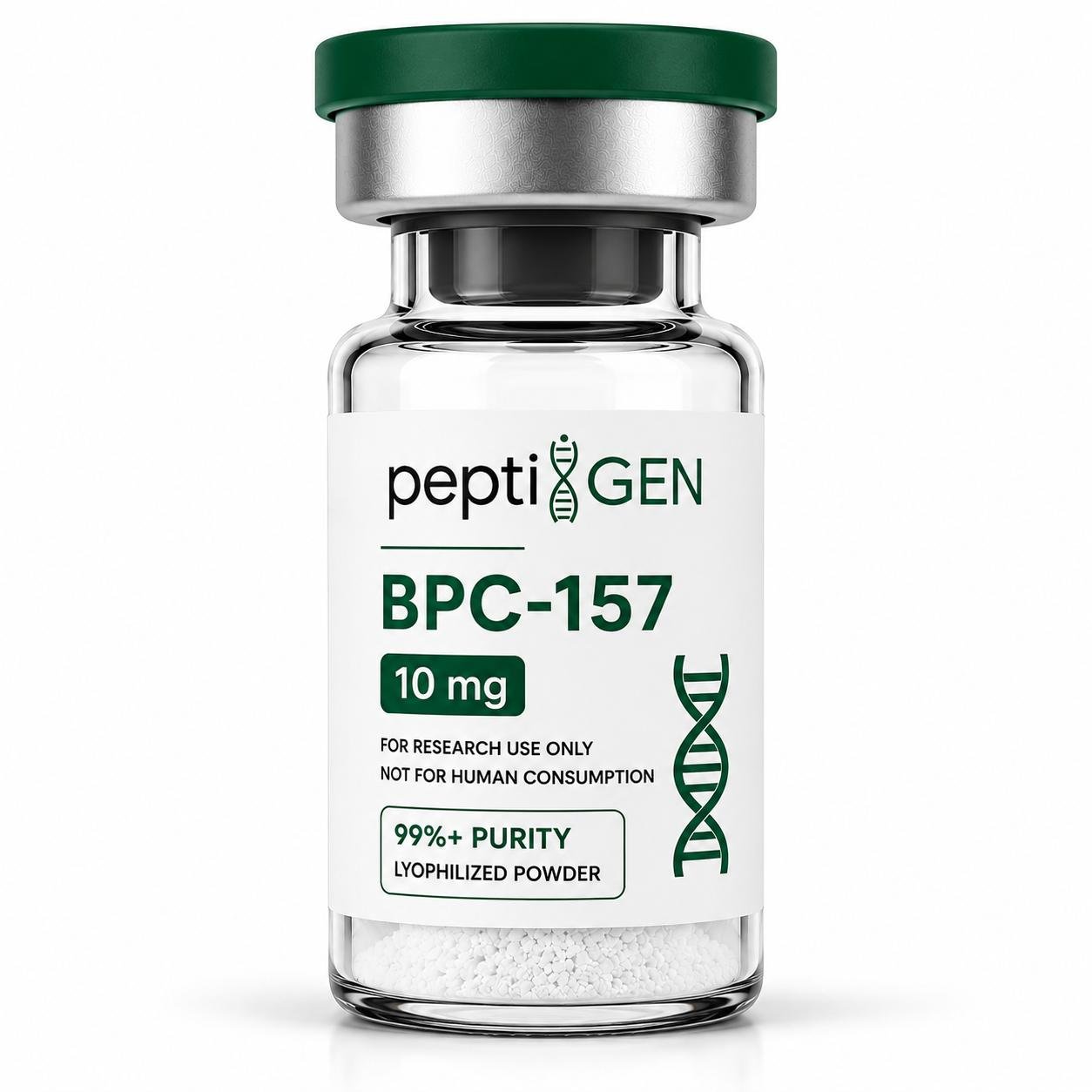
BPC-157 10mg is a high-purity lyophilized research compound supplied for scientific research and laboratory development only. This presentation contains 10 mg per vial. Every batch is analyzed by HPLC for purity and by mass spectrometry for identity; the certificate of analysis is available on request.
Mechanism of action
BPC-157 is a pentadecapeptide (GEPPPGKPADDAGLV) derived from a protein in human gastric juice, notably stable in acidic media. Its best-documented pathway is angiogenesis via VEGF and the VEGFR2–Akt–eNOS axis. Evidence is preclinical; it has been on the WADA Prohibited List (S0) since January 2022.
Structure and origin
BPC-157 is a pentadecapeptide: fifteen amino acids with the sequence Gly-Glu-Pro-Pro-Pro-Gly-Lys-Pro-Ala-Asp-Asp-Ala-Gly-Leu-Val (GEPPPGKPADDAGLV).
It is not a molecule designed from scratch. It corresponds to a fragment of a protein found in human gastric juice, which is where its name comes from: Body Protection Compound. That origin explains its most-cited property: it resists degradation in acidic media, something unusual among peptides that shapes the design of experimental protocols.
Mechanism in detail
The best-documented pathway in the literature is the angiogenic one, and it is characterized with reasonable precision: BPC-157 increases the expression of vascular endothelial growth factor (VEGF) and activates the VEGFR2 → Akt → eNOS signaling axis.
That axis is worth unpacking, because it explains the research interest:
- VEGFR2 is the main receptor of vascular endothelial growth factor, the one that triggers the formation of new vessels.
- Akt is a central kinase in cell-survival and proliferation pathways.
- eNOS is endothelial nitric oxide synthase, which produces nitric oxide and regulates vascular tone.
Together, it is a pathway linking new-vessel signaling with cell survival and flow regulation. That is why the molecule is studied in settings where vascular supply conditions tissue remodeling.
The actual state of the evidence
This deserves plain language, because there is a lot of confusion around it. The evidence on BPC-157 is preclinical: it comes from animal models, mainly rodents. There are no advanced-phase human clinical trials supporting its use.
That said, the volume of preclinical literature is considerable and covers very different tissues:
- Tendon and connective tissue
- Gastric and intestinal mucosa, including the intestinal barrier
- Fistulas
- Spinal cord and brain tissue
That breadth is exactly what keeps the scientific interest alive, and also what demands caution: an effect reported in rodents does not automatically translate to humans.
Regulatory and anti-doping status
BPC-157 has no regulatory approval for human therapeutic use in any jurisdiction, and no INVIMA registration in Colombia.
There is also a fact every researcher connected to sport must know: since January 2022 it has been on the World Anti-Doping Agency (WADA) Prohibited List, in category S0, non-approved substances, prohibited at all times, in and out of competition.
Category S0 covers pharmacological substances with no current regulatory approval for human therapeutic use. No therapeutic use exemptions (TUEs) exist for BPC-157, and its detection in a control leads to disqualification.
| Approval for human use | None |
|---|---|
| INVIMA registration | None |
| WADA list | S0 since January 2022 |
| Prohibition | At all times, in and out of competition |
| Therapeutic use exemptions | Not granted |
Safety: what is known and what is not
This should be answered clearly, because a lot of confusing information circulates.
There is no established human safety profile for this compound. It is not that studies found problems: it is that the studies that would establish such a profile have not been done. Those are two very different situations and they should not be confused.
What does exist:
- Preclinical literature, in cell and animal models, describing mechanisms of action.
- Analytical characterization of the material: purity by HPLC and identity by mass spectrometry.
What does not exist:
- Advanced-phase clinical trials establishing safety and efficacy in humans.
- Regulatory-agency approval for therapeutic use.
- INVIMA sanitary registration.
That is why the material is classified as a research reagent and not as a medicine. A supplier claiming otherwise is selling something it cannot support.
Specifications
| Compound | BPC-157 |
|---|---|
| Vial content | 10 mg |
| Form | Lyophilized powder in a sealed vial |
| Purity | Verified by HPLC, ≥ 99 % |
| Identity | Confirmed by mass spectrometry |
| Storage | Unreconstituted: controlled room temperature, away from light. Reconstituted: 2–8 °C. |
| Documentation | Certificate of analysis per batch, on request |
| Intended use | Scientific research and laboratory development |
Quality control and certificate of analysis
Every lot is analyzed before it is offered. Two independent tests are involved, and they answer different questions:
- HPLC (high-performance liquid chromatography) measures purity: what proportion of the sample is a single compound. The specification for this material is ≥ 99 %.
- Mass spectrometry confirms identity: that the compound’s measured mass matches the theoretical mass of the expected sequence.
Purity and identity are not the same thing: a sample can be 99 % pure of something that is not what was ordered. That is why both are reported. The certificate of analysis (CoA) of the lot, with its lot number, chromatogram and purity figure, is sent on request through WhatsApp before or after the order. If you are comparing suppliers, our guide on how to verify a peptide supplier explains how to read a CoA and which questions to ask.
Reconstitution and handling
The material ships lyophilized, its most stable form for transport and storage. For use in a protocol it is reconstituted with bacteriostatic water, which contains benzyl alcohol as a preservative and allows several draws from the same vial.
- Let the vial reach room temperature before opening, to avoid condensation.
- Disinfect both stoppers with isopropyl alcohol.
- Add the water slowly down the inner wall of the vial, never directly onto the powder.
- Swirl gently until fully dissolved. Do not shake: agitation can denature the peptide.
- Label with date and concentration, and refrigerate at 2–8 °C protected from light.
Bacteriostatic water available: Bacteriostatic Water 10 ml · Bacteriostatic Water 3 ml · Bacteriostatic Water 30 ml.
Storage and stability
Lyophilized peptides are stable compounds when kept dry, cold and in the dark. In practice:
- Unopened, lyophilized: controlled room temperature is acceptable for transport and short periods; for storage beyond a few weeks, keep refrigerated (2–8 °C) or frozen (−20 °C), always protected from light. Let the vial reach room temperature before opening so that no condensation forms on the powder.
- Reconstituted: refrigerate at 2–8 °C, protected from light, and use within the time frame of the protocol. Do not freeze the reconstituted solution repeatedly: freeze–thaw cycles degrade peptides.
- Multi-draw vials: when reconstituted with bacteriostatic water, the benzyl alcohol inhibits bacterial growth after the stopper is pierced, which is what allows several draws; the usual laboratory convention is to discard a multi-dose vial 28 days after the first puncture.
Research lines
- Angiogenesis (VEGF pathway)
- Tendon and connective tissue
- Gastrointestinal mucosa
Related guides
Technical articles from our research-guides section that expand on this compound and on how to evaluate a supplier:
Frequently asked questions
What evidence supports BPC-157?
Preclinical evidence, mainly rodent models, across tendon, GI mucosa and nervous tissue. There are no advanced human trials.
Can athletes use it?
No. It has been on the WADA Prohibited List (category S0) since January 2022, banned at all times, with no therapeutic use exemptions.
What is its exact sequence?
Fifteen amino acids: Gly-Glu-Pro-Pro-Pro-Gly-Lys-Pro-Ala-Asp-Asp-Ala-Gly-Leu-Val, abbreviated GEPPPGKPADDAGLV. It corresponds to a fragment of a protein in human gastric juice.
Which pathway is best documented?
Angiogenesis. BPC-157 increases VEGF expression and activates the VEGFR2 → Akt → eNOS axis, which links new-vessel signaling with cell survival and regulation of blood flow. The evidence is preclinical.
Is it safe?
There is no established human safety profile. The distinction matters: it is not that studies found problems, but that the studies that would establish such a profile have not been carried out. What does exist is preclinical literature on mechanisms and analytical characterization of the material.
Does it have documented side effects?
Not in an established way in humans, because there are no advanced-phase clinical trials that characterized them. The available literature is preclinical, in cell and animal models, and describes mechanisms of action, not human safety profiles.
What does the certificate of analysis include?
The lot number, the HPLC chromatogram with the purity figure (specification ≥ 99 %) and the mass-spectrometry identity confirmation. It is sent on request through WhatsApp, before or after the order.
How should it be stored?
Lyophilized: cold, dry and in the dark; refrigerated or frozen for long storage, with the vial brought to room temperature before opening. Reconstituted: 2–8 °C, protected from light, without repeated freezing.
How do I place an order?
Through WhatsApp, in English or Spanish. We confirm availability, shipping cost to your city or country and the payment method before closing the order. There is no online checkout and we do not store card data.
How is it shipped?
Lyophilized, in discreet packaging with a tracking number, across Colombia and to the United States and Spain. Orders are confirmed on WhatsApp in English or Spanish.
References
- Preclinical literature on the gastric pentadecapeptide BPC 157 and its modulating effect on angiogenesis in muscle and tendon repair, Journal of Physiology and Pharmacology.
- Literature and patent review on the multifunctionality and possible medical application of the peptide BPC 157 (review indexed in PubMed Central).
- World Anti-Doping Agency — Prohibited List, category S0.
Product intended exclusively for scientific research and laboratory development. Not for human or animal consumption. It is not a medicine and holds no INVIMA sanitary registration. The information on this page describes published research lines and does not constitute medical advice.
Reviews
There are no reviews yet.