Description
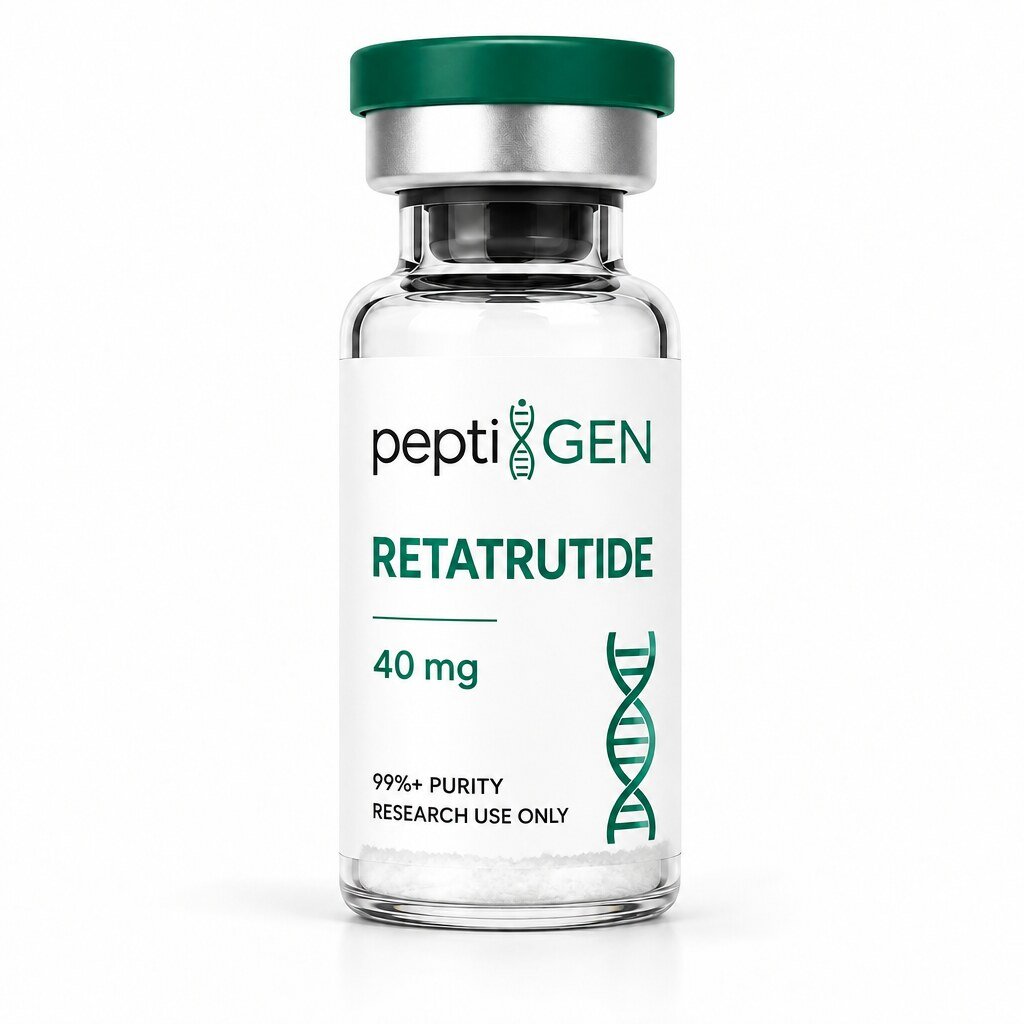
Retatrutide 40mg is a high-purity lyophilized research compound supplied for scientific research and laboratory development only. This presentation contains 40 mg per vial. Every batch is analyzed by HPLC for purity and by mass spectrometry for identity; the certificate of analysis is available on request.
Mechanism of action
Retatrutide is a synthetic peptide described as a triple agonist: it acts simultaneously on the GIP, GLP-1 and glucagon receptors. The glucagon component is what separates it from dual agonists and concentrates research interest in energy expenditure. A C20 fatty diacid binds it reversibly to albumin, giving a half-life of about 6 days. It is in Phase 3 development (TRIUMPH program) and is not approved by any regulator.
Mechanism of action, receptor by receptor
Calling Retatrutide a “triple agonist” is correct but incomplete. Each of the three receptors contributes a different pathway, and the scientific interest in the molecule lies precisely in how those pathways interact. It is the first triple agonist of these three receptors to reach clinical development.
GLP-1 receptor (GLP-1R)
Glucagon-like peptide 1 is an intestinal incretin released in response to food intake. Its receptor is expressed in pancreatic beta cells, in the gastrointestinal tract and in central nervous system nuclei involved in appetite regulation.
In the literature, activation of this pathway is associated with three studied effects: glucose-dependent insulin secretion, slower gastric emptying and central satiety signaling. It is the best-characterized of the three pathways and the one shared by every incretin agonist.
GIP receptor (GIPR)
Glucose-dependent insulinotropic polypeptide is the other main incretin. Its receptor is present in the pancreas and, notably, in adipose tissue, which sets it apart from the GLP-1 profile.
That distribution is what makes joint activation interesting: while the GLP-1 pathway works on satiety and gastric emptying, the GIP pathway is studied for its role in energy-substrate handling and adipocyte sensitivity. Studies with dual agonists suggest that activating both produces an effect distinct from activating GLP-1 alone.
Glucagon receptor (GCGR)
This is the component that separates Retatrutide from dual agonists, and the most counter-intuitive one. Glucagon is known above all for raising blood glucose, which would seem to run against a metabolic goal.
But its receptor is abundantly expressed in the liver, where it takes part in substrate mobilization and energy expenditure. The hypothesis under investigation is that, with the incretin action controlling glycemia at the same time, the glucagon component can add energy expenditure without the hyperglycemic effect it would have in isolation. That three-pathway interaction is the central object of study of the molecule.
Pharmacokinetics
The structure of Retatrutide incorporates a 20-carbon diacid fatty acid (C20). That modification is not decorative: it determines the molecule’s behavior over time.
The fatty chain lets the molecule bind reversibly to plasma albumin, an abundant and long-circulating protein. Travelling bound to it, the peptide escapes the rapid renal clearance it would suffer in free form. The result is an approximate half-life of 6 days, compatible with the once-weekly schedules used in clinical protocols.
| Structural modification | C20 diacid fatty acid |
|---|---|
| Extension mechanism | Reversible binding to plasma albumin |
| Approximate half-life | ≈ 6 days |
| Dosing interval in trials | Weekly |
| Target receptors | GIPR · GLP-1R · GCGR |
One nuance is worth stating: the exact half-life value is not published as a single figure in the main trial papers. The six-day approximation comes from the available pharmacokinetic data and is consistent with the dosing interval used.
What the published trials show
Retatrutide is in phase 3 of clinical development within the TRIUMPH program, started in 2023 by its originator laboratory. It is a registrational program: its purpose is to support an eventual application for approval.
- TRIUMPH-2: adults with obesity or overweight and type 2 diabetes. A mean body-weight reduction of up to 20.8 % at 80 weeks was reported.
- TRIUMPH-3: adults with severe obesity and established cardiovascular disease, with or without type 2 diabetes. A mean reduction of up to 22.6 % at 80 weeks was reported.
These results belong to the investigational drug, administered under supervised medical protocols in selected populations. They do not describe the laboratory material offered on this page and are not a claim about it.
Regulatory status
Retatrutide is not approved by any regulatory agency. It is an investigational molecule.
| Development phase | Phase 3 (TRIUMPH program) |
|---|---|
| FDA approval | No. The laboratory plans to file in 2027 |
| INVIMA registration (Colombia) | None |
| Classification of this material | Reagent for scientific research |
This has a practical consequence: any product offered as a retatrutide medicine, in Colombia or anywhere else, would sit outside the regulatory framework, because that medicine does not exist yet. Research material is a different category, intended for the laboratory and not for human use.
Safety and documented effects
It is the most frequently asked question about these molecules, and it deserves a precise answer rather than evasion.
Two things that are usually confused must be separated.
What the clinical literature reports
The trials of the investigational or approved drugs document a well-characterized adverse-effect profile, predominantly gastrointestinal (nausea, vomiting, diarrhea, constipation), generally dose-dependent and more frequent during initial dose escalation. That information comes from studies with thousands of participants under medical supervision and is recorded in the approved labels and the trial publications.
What applies to a laboratory reagent
This material has no established safety profile for human use, and the reason is structural, not a technicality:
- It is not manufactured under finished-product pharmaceutical standards.
- It carries no approved label or package insert.
- It has not passed a regulator’s review for that purpose.
- It has no INVIMA sanitary registration.
Attributing the medicine’s safety profile to it would be incorrect: they are different things, produced under different standards and intended for different uses. Anyone looking for the medicine should go to a pharmacy with a prescription.
Specifications
| Compound | Retatrutide |
|---|---|
| Vial content | 40 mg |
| Form | Lyophilized powder in a sealed vial |
| Purity | Verified by HPLC, ≥ 99 % |
| Identity | Confirmed by mass spectrometry |
| Storage | Unreconstituted: controlled room temperature, away from light. Reconstituted: 2–8 °C. |
| Documentation | Certificate of analysis per batch, on request |
| Intended use | Scientific research and laboratory development |
Quality control and certificate of analysis
Every lot is analyzed before it is offered. Two independent tests are involved, and they answer different questions:
- HPLC (high-performance liquid chromatography) measures purity: what proportion of the sample is a single compound. The specification for this material is ≥ 99 %.
- Mass spectrometry confirms identity: that the compound’s measured mass matches the theoretical mass of the expected sequence.
Purity and identity are not the same thing: a sample can be 99 % pure of something that is not what was ordered. That is why both are reported. The certificate of analysis (CoA) of the lot, with its lot number, chromatogram and purity figure, is sent on request through WhatsApp before or after the order. If you are comparing suppliers, our guide on how to verify a peptide supplier explains how to read a CoA and which questions to ask.
Reconstitution and handling
The material ships lyophilized, its most stable form for transport and storage. For use in a protocol it is reconstituted with bacteriostatic water, which contains benzyl alcohol as a preservative and allows several draws from the same vial.
- Let the vial reach room temperature before opening, to avoid condensation.
- Disinfect both stoppers with isopropyl alcohol.
- Add the water slowly down the inner wall of the vial, never directly onto the powder.
- Swirl gently until fully dissolved. Do not shake: agitation can denature the peptide.
- Label with date and concentration, and refrigerate at 2–8 °C protected from light.
Bacteriostatic water available: Bacteriostatic Water 10 ml · Bacteriostatic Water 3 ml · Bacteriostatic Water 30 ml.
Storage and stability
Lyophilized peptides are stable compounds when kept dry, cold and in the dark. In practice:
- Unopened, lyophilized: controlled room temperature is acceptable for transport and short periods; for storage beyond a few weeks, keep refrigerated (2–8 °C) or frozen (−20 °C), always protected from light. Let the vial reach room temperature before opening so that no condensation forms on the powder.
- Reconstituted: refrigerate at 2–8 °C, protected from light, and use within the time frame of the protocol. Do not freeze the reconstituted solution repeatedly: freeze–thaw cycles degrade peptides.
- Multi-draw vials: when reconstituted with bacteriostatic water, the benzyl alcohol inhibits bacterial growth after the stopper is pierced, which is what allows several draws; the usual laboratory convention is to discard a multi-dose vial 28 days after the first puncture.
Research lines
- Energy balance and body composition in experimental models
- Appetite signaling through incretin and glucagon pathways
- Comparison of triple versus dual agonism
Other presentations of Retatrutide
Related guides
Technical articles from our research-guides section that expand on this compound and on how to evaluate a supplier:
Frequently asked questions
How does Retatrutide differ from Tirzepatide?
Tirzepatide is a dual GIP/GLP-1 agonist. Retatrutide adds a third axis, the glucagon receptor, which is where the research interest in energy expenditure lies.
Is Retatrutide approved?
No. It is in Phase 3 clinical development and has no regulatory approval anywhere. This material is a research reagent, not a medicine.
What is the half-life of Retatrutide?
Approximately 6 days. That duration comes from its 20-carbon diacid fatty acid, which allows reversible binding to plasma albumin and prevents rapid clearance. It is what makes once-weekly administration possible in clinical protocols.
Why include the glucagon receptor if glucagon raises glucose?
That is the central question of the molecule. The glucagon receptor is abundant in the liver, where it takes part in substrate mobilization and energy expenditure. The hypothesis under study is that, with the incretin pathways controlling glycemia at the same time, that component can add energy expenditure without the hyperglycemic effect it would have in isolation.
Is Retatrutide approved?
No. It has no FDA approval, no INVIMA registration and no approval from any other agency: it is in phase 3 of clinical development. The material on this page is a reagent for laboratory research, a different category from a medicine.
Is this product safe?
It has no established safety profile for human use, and not on a technicality: it is not manufactured under finished-product pharmaceutical standards, carries no approved label or insert, has not passed regulatory review for that purpose and has no INVIMA sanitary registration. It is material intended for the laboratory.
What side effects does the literature report?
Clinical trials of the drugs in this family document a predominantly gastrointestinal profile (nausea, vomiting, diarrhea, constipation), dose-dependent and more frequent during initial escalation. That information refers to the medicine administered under medical supervision, not to this material.
What does the certificate of analysis include?
The lot number, the HPLC chromatogram with the purity figure (specification ≥ 99 %) and the mass-spectrometry identity confirmation. It is sent on request through WhatsApp, before or after the order.
How should it be stored?
Lyophilized: cold, dry and in the dark; refrigerated or frozen for long storage, with the vial brought to room temperature before opening. Reconstituted: 2–8 °C, protected from light, without repeated freezing.
How do I place an order?
Through WhatsApp, in English or Spanish. We confirm availability, shipping cost to your city or country and the payment method before closing the order. There is no online checkout and we do not store card data.
How is it shipped?
Lyophilized, in discreet packaging with a tracking number, across Colombia and to the United States and Spain. Orders are confirmed on WhatsApp in English or Spanish.
References
- Jastreboff AM et al. Triple-Hormone-Receptor Agonist Retatrutide for Obesity — A Phase 2 Trial. New England Journal of Medicine, 2023.
- ClinicalTrials.gov, TRIUMPH program records: NCT05882045, NCT05929066, NCT05931367.
- Phase 3 result communications from the originator laboratory (TRIUMPH-2 and TRIUMPH-3).
The references are cited as the source of the mechanism, pharmacokinetic and clinical-development data above. They concern the study of the molecule, not this product.
Product intended exclusively for scientific research and laboratory development. Not for human or animal consumption. It is not a medicine and holds no INVIMA sanitary registration. The information on this page describes published research lines and does not constitute medical advice.
Reviews
There are no reviews yet.